Conservative management of 3c biceps femoris intramuscular tendon injury: A case report of an elite-level inter-county Gaelic football player.
DOI:
https://doi.org/10.64255/5ce3qk51Keywords:
Biceps femoris, Intramuscular tendon injury, Isometric loading, Hamstring injuryAbstract
Introduction: Hamstring injuries are one of the most common injuries across many field-sports, including Gaelic football. Hamstring injuries involving the intramuscular tendon (IMT) are becoming increasingly common, and are associated with longer return-to-play times and greater recurrence. Rehabilitation guidelines for IMT hamstring injuries are not well-documented. The aim of this study was to detail the return-to-play (RTP) process of a Gaelic football player after intramuscular tendon (IMT) hamstring injury.
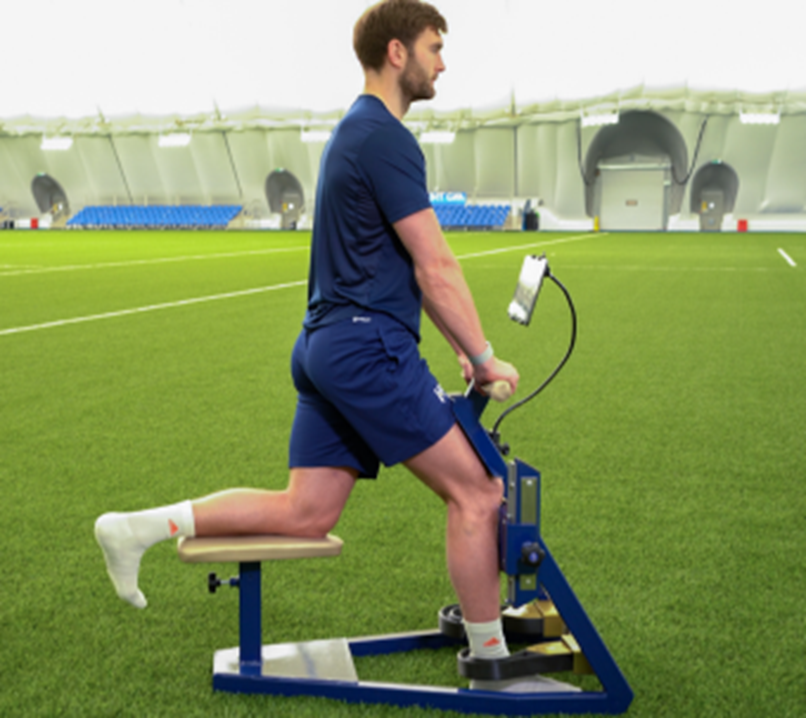
Methods: This case report involves a male, inter-county level, Gaelic football player, who sustained a type 3c biceps femoris injury during a competitive match. Rehabilitation involved the implementation of an early isometric loading programme using a unique hamstring isometric assessment device (HRIG) which replicates the late swing/early stance phase of running gait in an isometric position. In this unique rehabilitation approach, specific hamstring rehabilitation consisted of progressions in isometric loading alongside running progressions, as opposed to traditional programming involving hamstring-specific isotonic exercise.
Results: The player achieved a return-to-running (RTR) on day 19, return-to-training (RTT) on day
38, and RTP on day 48. Isometric hamstring force from the involved limb increased from 0.9 Nm/kg on clinical presentation, 2.13Nm/kg on RTR, 2.52Nm/kg on RTT, to 2.51Nm/kg on RTP. Additionally, isometric hamstring inter-limb asymmetry improved from 66% on clinical presentation (day 2), 20% on RTR, 4% on RTT, to 13% on RTP.
Conclusion: An early isometric loading programme restored isometric hamstring force and resulted in shorter a RTP time then typically reported for type 3c hamstring injuries.
References
1. Roe M, Murphy JC, Gissane C, Blake C. Hamstring injuries in elite Gaelic football: an 8-year investigation to identify injury rates, time-loss patterns and players at increased risk. British Journal of Sports Medicine. 2018;52(15):982-8.
2. Roe M, Murphy JC, Gissane C, Blake C. Time to get our four priorities right: an 8-year prospective investigation of 1326 player-seasons to identify the frequency, nature, and burden of time-loss injuries in elite Gaelic football. PeerJ. 2018;6:e4895.
3. Pollock N, James SLJ, Lee JC, Chakraverty R. British athletics muscle injury classification: a new grading system. British Journal of Sports Medicine. 2014;48(18):1347-51.
4. Brukner P, Connell D. 'Serious thigh muscle strains': beware the intramuscular tendon which plays an important role in difficult hamstring and quadriceps muscle strains. Br J Sports Med. 2016;50(4):205-8.
5. Purslow PP. The Structure and Role of Intramuscular Connective Tissue in Muscle Function. Front Physiol. 2020;11:495.
6. van der Made AD, Almusa E, Reurink G, et al. Intramuscular tendon injury is not associated with an increased hamstring reinjury rate within 12 months after return to play. Br J Sports Med. 2018;52(19):1261-6.
7. van der Made AD, Almusa E, Whiteley R, et al. Intramuscular tendon involvement on MRI has limited value for predicting time to return to play following acute hamstring injury. Br J Sports Med. 2018;52(2):83-8.
8. Comin J, Malliaras P, Baquie P, Barbour T, Connell D. Return to competitive play after hamstring injuries involving disruption of the central tendon. Am J Sports Med. 2013;41(1):111-5.
9. Pollock N, Patel A, Chakraverty J, Suokas A, James SL, Chakraverty R. Time to return to full training is delayed and recurrence rate is higher in intratendinous ('c') acute hamstring injury in elite track and field athletes: clinical application of the British Athletics Muscle Injury Classification. Br J Sports Med. 2016;50(5):305-10.
10. Järvinen TA, Järvinen M, Kalimo H. Regeneration of injured skeletal muscle after the injury. Muscles Ligaments Tendons J. 2013;3(4):337-45.
11. Bojsen-Møller J, Magnusson SP. Mechanical properties, physiological behavior, and function of aponeurosis and tendon. J Appl Physiol (1985). 2019;126(6):1800-7.
12. Kerin F, O'Flanagan S, Coyle J, et al. Intramuscular Tendon Injuries of the Hamstring Muscles: A More Severe Variant? A Narrative Review. Sports Med Open. 2023;9(1):75.
13. Pollock N, Kelly S, Lee J, et al. A 4-year study of hamstring injury outcomes in elite track and field using the British Athletics rehabilitation approach. British Journal of Sports Medicine. 2022;56(5):257-63.
14. Eggleston L, McMeniman M, Engstrom C. High-grade intramuscular tendon disruption in acute hamstring injury and return to play in Australian Football players. Scand J Med Sci Sports. 2020;30(6):1073-82.
15. Ricky S, Steven LJJ, Rajesh B, Kent AK, Gurjit B, Alison R. Association of the British Athletic Muscle Injury Classification and anatomic location with return to full training and reinjury following hamstring injury in elite football. BMJ Open Sport & Exercise Medicine. 2021;7(2):e001010.
16. Macdonald B, McAleer S, Kelly S, Chakraverty R, Johnston M, Pollock N. Hamstring rehabilitation in elite track and field athletes: applying the British Athletics Muscle Injury Classification in clinical practice. Br J Sports Med. 2019;53(23):1464-73.
17. Taberner M, O'Keefe J, Dunn A, Cohen DD. Return to sport and beyond following intramuscular tendon hamstring injury: A case report of an English Premier League football player. Phys Ther Sport. 2022;56:38-47.
18. Shrier I. Strategic Assessment of Risk and Risk Tolerance (StARRT) framework for return-to-play decision-making. Br J Sports Med. 2015;49(20):1311-5.
19. Mc Intyre ML, Mark; Baltzopoulos, Bill; and Reilly, Clive. RELIABILITY AND BILATERAL STRENGTH IMBALANCES OF A NEW ISOMETRIC TEST TO IDENTIFY PREVIOUS HAMSTRING STRAIN COMPARED TO ECCENTRIC STRENGTH. International Society of Biomechanics in Sport2022.
20. Chumanov ES, Heiderscheit BC, Thelen DG. The effect of speed and influence of individual muscles on hamstring mechanics during the swing phase of sprinting. J Biomech. 2007;40(16):3555-62.
21. Thelen DG, Chumanov ES, Best TM, Swanson SC, Heiderscheit BC. Simulation of biceps femoris musculotendon mechanics during the swing phase of sprinting. Med Sci Sports Exerc. 2005;37(11):1931-8.
22. Ono T, Higashihara A, Shinohara J, Hirose N, Fukubayashi T. Estimation of tensile force in the hamstring muscles during overground sprinting. Int J Sports Med. 2015;36(2):163-8.
23. Danielsson A, Horvath A, Senorski C, et al. The mechanism of hamstring injuries – a systematic review. BMC Musculoskeletal Disorders. 2020;21(1):641.
24. Lanza MB, Balshaw TG, Folland JP. Is the joint-angle specificity of isometric resistance training real? And if so, does it have a neural basis? Eur J Appl Physiol. 2019;119(11-12):2465-76.
25. Oranchuk DJ, Storey AG, Nelson AR, Cronin JB. Isometric training and long-term adaptations: Effects of muscle length, intensity, and intent: A systematic review. Scand J Med Sci Sports. 2019;29(4):484-503.
26. Glasgow P, Phillips N, Bleakley C. Optimal loading: key variables and mechanisms. British Journal of Sports Medicine. 2015;49(5):278-9.
27. Kubo K, Kanehisa H, Fukunaga T. Effects of different duration isometric contractions on tendon elasticity in human quadriceps muscles. J Physiol. 2001;536(Pt 2):649-55.
28. Taberner M, Allen T, Cohen DD. Progressing rehabilitation after injury: consider the 'control-chaos continuum'. Br J Sports Med. 2019;53(18):1132-6.
29. Theodoropoulos JS, Bettle J, Kosy JD. The use of GPS and inertial devices for player monitoring in team sports: A review of current and future applications. Orthop Rev (Pavia). 2020;12(1):7863.
30. Malone S, Solan B, Collins K. The Running Performance Profile of Elite Gaelic Football Match-Play. The Journal of Strength & Conditioning Research. 2017;31(1):30-6.
31. Baldock J, Wright S, McNally E, Wedatilake T. Intratendinous hamstring injuries: sequential MRIs as a tool to reduce the risk of reinjury in elite sport. BMJ Case Rep. 2021;14(11).
32. Lum D, Barbosa TM. Brief Review: Effects of Isometric Strength Training on Strength and Dynamic Performance. Int J Sports Med. 2019;40(6):363-75.
33. Thelen DG, Chumanov ES, Hoerth DM, et al. Hamstring muscle kinematics during treadmill sprinting. Med Sci Sports Exerc. 2005;37(1):108-14.
34. Magnusson SP, Langberg H, Kjaer M. The pathogenesis of tendinopathy: balancing the response to loading. Nat Rev Rheumatol. 2010;6(5):262-8.
35. Kalkhoven JT, Lukauskis-Carvajal M, Sides DL, McLean BD, Watsford ML. A Conceptual Exploration of Hamstring Muscle-Tendon Functioning during the Late-Swing Phase of Sprinting: The Importance of Evidence-Based Hamstring Training Frameworks. Sports Med. 2023;53(12):2321-46.
36. Liu Y, Sun Y, Zhu W, Yu J. The late swing and early stance of sprinting are most hazardous for hamstring injuries. J Sport Health Sci. 2017;6(2):133-6.
37. Yu B, Queen RM, Abbey AN, Liu Y, Moorman CT, Garrett WE. Hamstring muscle kinematics and activation during overground sprinting. J Biomech. 2008;41(15):3121-6.
38. Van Hooren B, Bosch F. Is there really an eccentric action of the hamstrings during the swing phase of high-speed running? part I: A critical review of the literature. J Sports Sci. 2017;35(23):2313-21.
39. Van Hooren B, Bosch F. Is there really an eccentric action of the hamstrings during the swing phase of high-speed running? Part II: Implications for exercise. J Sports Sci. 2017;35(23):2322-33.
Downloads
Published
Issue
Section
License
Copyright (c) 2026 Copyright is retained by authors (or their institutions)

This work is licensed under a Creative Commons Attribution 4.0 International License.
This license enables re-users to distribute, remix, adapt, and build upon the material in any medium or format, so long as attribution is given to the creator. The license allows for commercial use. CC BY includes the following elements:
 BY: credit must be given to the creator.