The relationship between sex, symptom severity and the risk of exercise intolerance in adolescents following sport-related concussion.
DOI:
https://doi.org/10.64255/qqc60953Keywords:
Sport-Related Concussion , Exercise Intolerance, Sex Differences, Exercise PhysiologyAbstract
Introduction: Exercise intolerance is a risk factor for prolonged recovery following sport-related concussion (SRC) in adolescents. Evidence suggests adolescent females are at increased risk of exercise intolerance and report higher symptom severity compared to males. Thus, this study examined if the association between sex and risk of exercise intolerance was either moderated or mediated by symptom severity.
Methods: Within 14-days of SRC, adolescents participating in the pan-Canadian SHRed Concussions study reported SCAT5 symptom severity score (SSS) and completed a Buffalo Concussion Treadmill Test (BCTT). The BCTT was terminated following a 3/10 increase in concussion symptoms (exercise intolerant) or volitional fatigue (>180bpm, >18/20 rating of perceived exertion; exercise tolerant). Moderation of sex effects on exercise intolerance risk by SSS were evaluated by likelihood ratio tests. Mediation by SSS was evaluated using the parametric g formula with bootstrap standard errors.
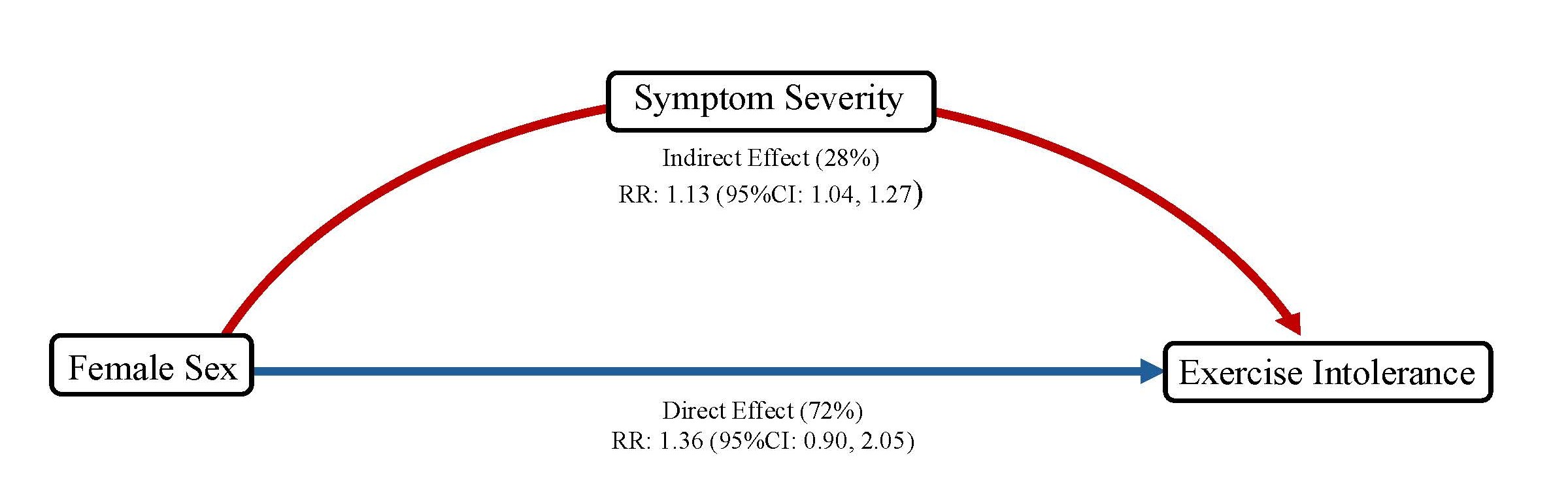
Results: 281 adolescents (126 male, 155 female) were included. 204 (100 male, 104 female) were tolerant to exercise and 77 (26 male, 51 female) were intolerant. Multivariable analysis revealed that 1 unit of square root SSS higher symptom severity was associated with increased risk (RR=1.16; 95% CI: 1.06, 1.27) while sex was associated with non-significant increased risk (RR=1.36; 95% CI: 0.90, 2.05) of exercise intolerance. Moderation assessed via likelihood ratio test was not significant (X2(1)=1.50, p=0.221). Mediation results showed significant indirect effects of sex through SSS (RR=1.131; 95% CI: 1.035, 1.272), accounting for 28% of the estimated total effects (RR=1.570; 95% CI: 0.986, 2.418) while direct effects, which explained a larger proportion of total effects (72%) were not significant (RR=1.36; 95% CI: 0.90, 2.05).
Conclusion: Potential sex differences in the risk of exercise intolerance following SRC are partially explained by differences SSS. The larger yet imprecisely estimated direct effects of sex on risk of exercise intolerance highlighting the presence of additional pathways which are distinct from symptomology and warrant further investigation.
References
1. Eime RM, Young JA, Harvey JT, Charity MJ, Payne WR. A systematic review of the psychological and social benefits of participation in sport for children and adolescents: informing development of a conceptual model of health through sport. Int J Behav Nutr Phys Act. 2013;10(1):98. doi:10.1186/1479-5868-10-98
2. Mills K, Dudley D, Collins NJ. Do the benefits of participation in sport and exercise outweigh the negatives? An academic review. Best Pract Res Clin Rheumatol. 2019 Feb 1;Regional Musculoskeletal Problems with a Focus on Sport33(1):172–87. doi:10.1016/j.berh.2019.01.015
3. Emery C, Tyreman H. Sport participation, sport injury, risk factors and sport safety practices in Calgary and area junior high schools. Paediatr Child Health. 2009 Sep 1;14(7):439–44. doi:10.1093/pch/14.7.439
4. Emery CA, Pasanen K. Current trends in sport injury prevention. Best Pract Res Clin Rheumatol. 2019 Feb;33(1):3–15. doi:10.1016/j.berh.2019.02.009 PubMed PMID: 31431273.
5. Patricios JS, Schneider KJ, Dvorak J, Ahmed OH, Blauwet C, Cantu RC, et al. Consensus statement on concussion in sport: the 6th International Conference on Concussion in Sport–Amsterdam, October 2022. Br J Sports Med. 2023 Jun;57(11):695–711. doi:10.1136/bjsports-2023-106898
6. Murdaugh DL, Ono KE, Morris SO, Burns TG. Effects of Developmental Age on Symptom Reporting and Neurocognitive Performance in Youth After Sports-Related Concussion Compared to Control Athletes. J Child Neurol. 2018 Jun 1;33(7):474–81. doi:10.1177/0883073818766815
7. Zemek R, Barrowman N, Freedman SB, Gravel J, Gagnon I, McGahern C, et al. Clinical Risk Score for Persistent Postconcussion Symptoms Among Children With Acute Concussion in the ED. JAMA. 2016 Mar 8;315(10):1014–25. doi:10.1001/jama.2016.1203 PubMed PMID: 26954410.
8. Leddy JJ, Burma JS, Toomey CM, Hayden A, Davis GA, Babl FE, et al. Rest and exercise early after sport-related concussion: a systematic review and meta-analysis. Br J Sports Med. 2023 Jun;57(12):762–70. doi:10.1136/bjsports-2022-106676
9. Leddy JJ, Willer B. Use of graded exercise testing in concussion and return-to-activity management. Curr Sports Med Rep. 2013;12(6):370–6. doi:10.1249/JSR.0000000000000008 PubMed PMID: 24225521.
10. Miutz LN, Burma JS, Brassard P, Phillips AA, Emery CA, Smirl JD. Comparison of the Buffalo Concussion Treadmill Test With a Physiologically Informed Cycle Test: Calgary Concussion Cycle Test. Sports Health. 2024;16(5):837–50. doi:10.1177/19417381231217744 PubMed PMID: 38149331; PubMed Central PMCID: PMC11346228.
11. Haider MN, Johnson SL, Mannix R, Macfarlane AJ, Constantino D, Johnson BD, et al. The Buffalo Concussion Bike Test for Concussion Assessment in Adolescents. Sports Health. 2019 Nov 1;11(6):492–7. doi:10.1177/1941738119870189
12. Smirl JD, Burkart JJ, Neill MG, Galarneau JM, Fletcher EKS, Burma JS, et al. CARE-ing for concussions: Development of the Calgary Adapted aRm Ergometer (CARE) exertion test: A physiological alternative to the Calgary Concussion Cycle Test. Exp Physiol. n/a(n/a). doi:10.1113/EP093263
13. Orr R, Bogg T, Fyffe A, Lam LT, Browne GJ. Graded Exercise Testing Predicts Recovery Trajectory of Concussion in Children and Adolescents. Clin J Sport Med Off J Can Acad Sport Med. 2021 Jan;31(1):23–30. doi:10.1097/JSM.0000000000000683 PubMed PMID: 30439726.
14. Neill MG, Miutz LN, Chadder MK, Galarneau JM, Burkart JJ, Smirl JD, et al. Exercise intolerance and time to medical clearance to return to sport following sport-related concussion in adolescents. BMJ Open Sport Exerc Med. 2025 Nov 5;11(4). doi:10.1136/bmjsem-2025-002806 PubMed PMID: 10.1136/bmjsem-2025-002806.
15. Thorne J, Hellewell SC, Cowen G, Ring A, Jefferson A, Chih H, et al. Symptoms Associated With Exercise Intolerance and Resting Heart Rate Following Mild Traumatic Brain Injury. J Head Trauma Rehabil. 2024 Oct;39(5):E381. doi:10.1097/HTR.0000000000000928
16. Putukian M, Purcell L, Schneider KJ, Black AM, Burma JS, Chandran A, et al. Clinical recovery from concussion-return to school and sport: a systematic review and meta-analysis. Br J Sports Med. 2023 Jun;57(12):798–809. doi:10.1136/bjsports-2022-106682 PubMed PMID: 37316183.
17. Brown DA, Elsass JA, Miller AJ, Reed LE, Reneker JC. Differences in Symptom Reporting Between Males and Females at Baseline and After a Sports-Related Concussion: A Systematic Review and Meta-Analysis. Sports Med. 2015 Jul 1;45(7):1027–40. doi:10.1007/s40279-015-0335-6
18. Shill IJ, van den Berg C, West SW, Galarneau JM, Fraser K, Schneider KJ, et al. Is a Neuromuscular Training Warm-Up Enough for Injury and Concussion Prevention in High School Girl Rugby Players? J Orthop Sports Phys Ther. 2026 Mar 2;1–27. doi:10.2519/jospt.2026.13373
19. Garra G, Singer AJ, Taira BR, Chohan J, Cardoz H, Chisena E, et al. Validation of the Wong-Baker FACES Pain Rating Scale in pediatric emergency department patients. Acad Emerg Med Off J Soc Acad Emerg Med. 2010 Jan;17(1):50–4. doi:10.1111/j.1553-2712.2009.00620.x PubMed PMID: 20003121.
20. Valeri L, Vanderweele TJ. Mediation analysis allowing for exposure-mediator interactions and causal interpretation: theoretical assumptions and implementation with SAS and SPSS macros. Psychol Methods. 2013 Jun;18(2):137–50. doi:10.1037/a0031034 PubMed PMID: 23379553; PubMed Central PMCID: PMC3659198.
21. Neill MG, Miutz LN, Chadder MK, Galarneau JM, Burkart JJ, Smirl JD, et al. Exercise intolerance and time to medical clearance to return to sport following sport-related concussion in adolescents. BMJ Open Sport Exerc Med. 2025 Nov 5;11(4). doi:10.1136/bmjsem-2025-002806 PubMed PMID: 10.1136/bmjsem-2025-002806.
22. VanderWeele TJ. Explanation in causal inference: developments in mediation and interaction. Int J Epidemiol. 2016 Dec;45(6):1904–8. doi:10.1093/ije/dyw277 PubMed PMID: 27864406; PubMed Central PMCID: PMC6373498.
23. Shill IJ, West SW, Sick S, Schneider KJ, Wiley JP, Hagel BE, et al. Differences in injury and concussion rates in a cohort of Canadian female and male youth Rugby Union: a step towards targeted prevention strategies. Br J Sports Med. 2023 Nov 20;bjsports-2023-106929. doi:10.1136/bjsports-2023-106929 PubMed PMID: 37985003.
24. Cheng J, Ammerman B, Santiago K, Jivanelli B, Lin E, Casey E, et al. Sex-Based Differences in the Incidence of Sports-Related Concussion: Systematic Review and Meta-analysis. Sports Health. 2019 Sep 30;11(6):486–91. doi:10.1177/1941738119877186 PubMed PMID: 31567052; PubMed Central PMCID: PMC6822209.
25. Shill IJ, Shepherd HA, Eliason PH, Kolstad AT, Heyward O, Martens G, et al. Prevention strategies and modifiable risk factors for concussion: a systematic review and meta-analysis for the Female, woman and girl Athlete Injury pRevention (FAIR) consensus. Br J Sports Med. 2025 Sep 19;bjsports-2025-109915. doi:10.1136/bjsports-2025-109915
26. Schneider KJ, Critchley ML, Anderson V, Davis GA, Debert CT, Feddermann-Demont N, et al. Targeted interventions and their effect on recovery in children, adolescents and adults who have sustained a sport-related concussion: a systematic review. Br J Sports Med. 2023 Jun 1;57(12):771–9. doi:10.1136/bjsports-2022-106685 PubMed PMID: 37316188.
27. Zynda AJ, Trbovich AM, Kehinde F, Burley C, Collins MW, Okonkwo DO, et al. Role of anxiety in exercise intolerance and autonomic nervous system dysfunction post-concussion. Neurol Sci. 2025 Apr 28. doi:10.1007/s10072-025-08204-9
28. Neill MG, Burma JS, Miutz LN, Kennedy CM, Penner LC, Newel KT, et al. Transcranial Doppler Ultrasound and Concussion-Supplemental Symptoms with Physiology: A Systematic Review. J Neurotrauma. 2024 Apr 8. doi:10.1089/neu.2023.0421 PubMed PMID: 38468559.
29. Smith KJ, Ainslie PN. Regulation of cerebral blood flow and metabolism during exercise. Exp Physiol. 2017;102(11):1356–71. doi:10.1113/EP086249
30. Douglas AJM, Talbot JS, Perkins D, Dawkins TG, Oliver JL, Lloyd RS, et al. The influence of maturation and sex on intracranial blood velocities during exercise in children. J Appl Physiol. 2024 Mar;136(3):451–9. doi:10.1152/japplphysiol.00478.2023
31. Pertab JL, Merkley TL, Cramond AJ, Cramond K, Paxton H, Wu T. Concussion and the autonomic nervous system: An introduction to the field and the results of a systematic review. Neurorehabilitation. 42(4):397–427. doi:10.3233/NRE-172298 PubMed PMID: 29660949; PubMed Central PMCID: PMC6027940.
32. Tan CO, Meehan WP, Iverson GL, Taylor JA. Cerebrovascular regulation, exercise, and mild traumatic brain injury. Neurology. 2014 Oct 28;83(18):1665–72. doi:10.1212/WNL.0000000000000944 PubMed PMID: 25274845; PubMed Central PMCID: PMC4223082.
33. Wright AD, Smirl JD, Bryk K, Fraser S, Jakovac M, Van Donkelaar P. Sport-Related Concussion Alters Indices of Dynamic Cerebral Autoregulation. Front Neurol. 2018 Mar 27;9:196. doi:10.3389/fneur.2018.00196
34. Burma JS, Neill MG, Fletcher EKS, Dennett BE, Johnson NE, Javra R, et al. Examining the upper frequency limit of dynamic cerebral autoregulation: Considerations across the cardiac cycle during eucapnia. Exp Physiol. 2024;109(12):2100–21. doi:10.1113/EP091719
35. Johnson NE, Burma JS, Neill MG, Burkart JJ, Fletcher EKS, Smirl JD. Challenging dynamic cerebral autoregulation across the physiological CO2 spectrum: Influence of biological sex and cardiac cycle. Exp Physiol. 2025;110(1):147–65. doi:10.1113/EP092245
36. Fierstra J, Sobczyk O, Battisti-Charbonney A, Mandell DM, Poublanc J, Crawley AP, et al. Measuring cerebrovascular reactivity: what stimulus to use?: Measuring cerebrovascular reactivity. J Physiol. 2013 Dec 1;591(23):5809–21. doi:10.1113/jphysiol.2013.259150
37. Kety SS, Schmidt CF. The effects of altered arterial tensions of carbon dioxide and oxygen on cerebral blood flow and cerebral oxygen consumption of normal young men. J Clin Invest. 1948 Jul 1;27(4):484–92. doi:10.1172/JCI101995
38. Burma JS, Virk S, Smirl JD. Systolic versus diastolic differences in cerebrovascular reactivity to hypercapnic and hypocapnic challenges. Eur J Appl Physiol. 2025 Feb 1;125(2):429–42. doi:10.1007/s00421-024-05621-0
39. Purkayastha S, Sorond FA, Lyng S, Frantz J, Murphy MN, Hynan LS, et al. Impaired Cerebral Vasoreactivity Despite Symptom Resolution in Sports-Related Concussion. J Neurotrauma. 2019 Aug 15;36(16):2385–90. doi:10.1089/neu.2018.5861
40. Howell DR, Hunt DL, Aaron SE, Hamner JW, Meehan WP, Tan CO. Association of Hemodynamic and Cerebrovascular Responses to Exercise With Symptom Severity in Adolescents and Young Adults With Concussion. Neurology. 2021 Nov 30;97(22):e2204–12. doi:10.1212/WNL.0000000000012929 PubMed PMID: 34635563; PubMed Central PMCID: PMC8641971.
41. Clausen M, Pendergast DR, Willer B, Leddy J. Cerebral Blood Flow During Treadmill Exercise Is a Marker of Physiological Postconcussion Syndrome in Female Athletes. J Head Trauma Rehabil. 2016 May;31(3):215–24. doi:10.1097/HTR.0000000000000145
42. Javra R, Burma JS, Johnson NE, Smirl JD. Feasibility of superimposed supine cycling and lower body negative pressure as an effective means of prolonging exercise tolerance in individuals experiencing persisting post-concussive symptoms: Preliminary results. Exp Physiol. n/a(n/a). doi:10.1113/EP091677
Downloads
Published
Issue
Section
License
Copyright (c) 2026 Journal of Injury & Illness Prevention in Sport

This work is licensed under a Creative Commons Attribution 4.0 International License.
This license enables re-users to distribute, remix, adapt, and build upon the material in any medium or format, so long as attribution is given to the creator. The license allows for commercial use. CC BY includes the following elements:
 BY: credit must be given to the creator.