Self-Determination Theory and Injury-Mitigating Health Behaviours and Outcomes in Physically Demanding Performance Settings: A Systematic Review
DOI:
https://doi.org/10.64255/gxg6e451Keywords:
Motivational Regulation, Self-determination theory, musculoskeletal injuries, injury mitigation, high-performance settingAbstract
Introduction: Musculoskeletal injuries (MSKIs) are prevalent across physically demanding performance environments, including competitive sport and high-demand occupations, impacting health, performance and organisational operations. Self-Determination Theory (SDT) can be applied within these contexts to understand how motivational regulation impacts protective behaviours and injury risk. However, SDT research and its constructs in relation to injury-related processes and outcomes have not been consolidated to inform interventions. Therefore, this systematic review investigated associations between SDT motivational constructs and injury-mitigating health behaviours and outcomes in physically demanding performance settings.
Methods: A search of five electronic databases identified studies published between 1985 and 2026 involving participants (≥16 years) in sport or occupational performance contexts. This yielded 10,838 studies, with 26 studies meeting the inclusion criteria across sporting, military, police and firefighter settings.
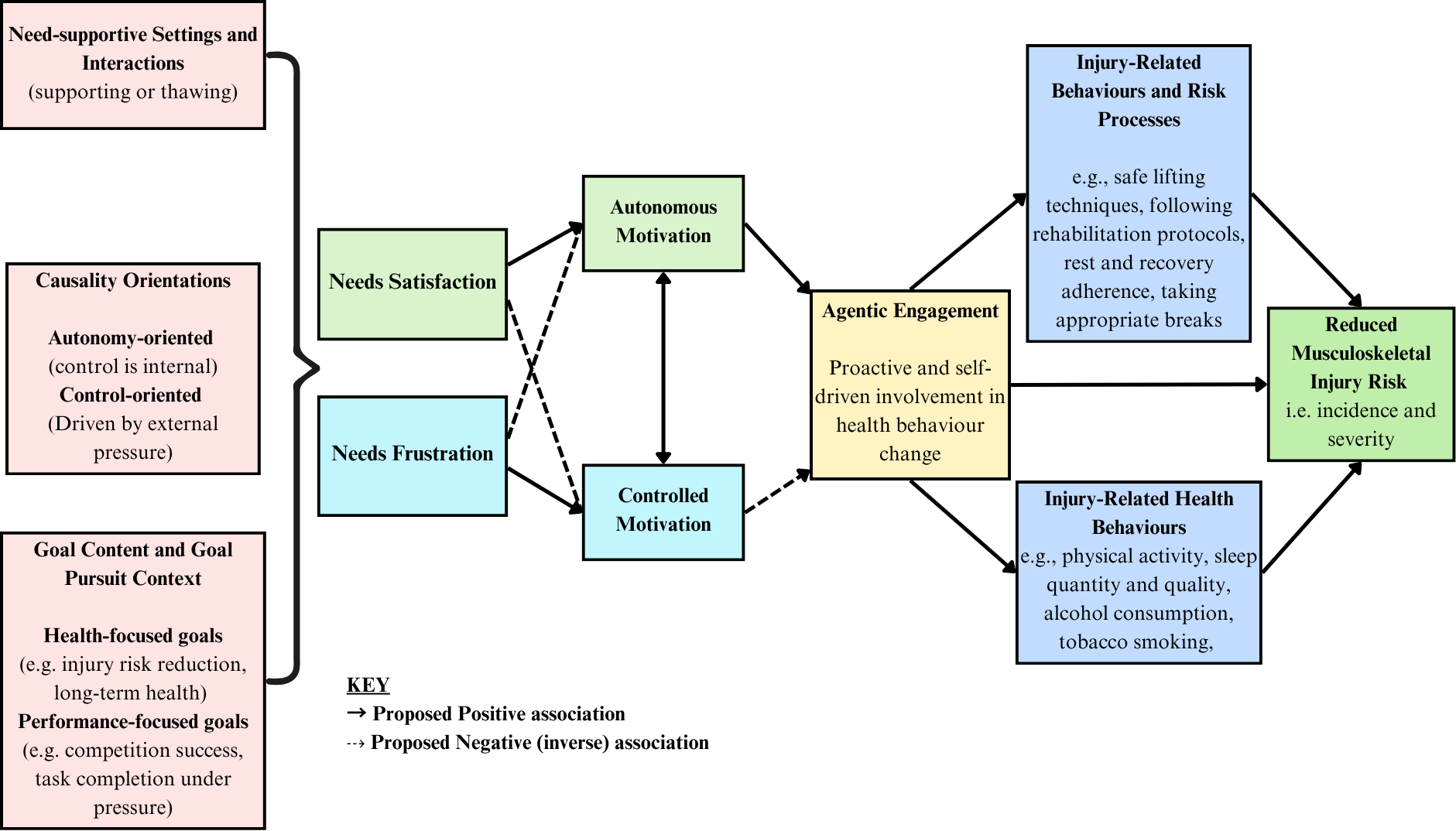
Results: Autonomous motivation and psychological need satisfaction were associated with greater engagement in injury-mitigating health behaviours and protective practices, with more limited evidence for lower injury risk and improved rehabilitation outcomes. Models through which these mechanisms might occur are presented. Evidence is presented suggesting individuals may internalise health-directed goals despite external demands, allowing autonomous and controlled motivations to coexist. We therefore hypothesise a contextual extension of the SDT process model in which positive agentic engagement may support the translation of internalised health behaviours into effective injury mitigation.
Conclusion: Although the evidence base was limited by predominantly self-reported, cross-sectional designs, restricting causal inference, this review provides a foundation for future longitudinal research and the development of theory-informed injury mitigation interventions in physically demanding performance settings.
References
1. Sammito S, Hadzic V, Karakolis T, Kelly KR, Proctor SP, Stepens A, et al. Risk factors for musculoskeletal injuries in the military: a qualitative systematic review of the literature from the past two decades and a new prioritizing injury model. Military Medical Research. 2021;8(1):66.
2. Pandey N, Bindra S. Prevalence and Risk Factors of Musculoskeletal Disorders Among Police Employees: A Survey Study. International Journal of Science and Healthcare Research. 2023;8:124-31.
3. Tahernejad S, Farahi-Ashtiani I, Veisani Y, Ghaffari S, Sahebi A, Makki F. A systematic review and meta-analysis of musculoskeletal disorders among firefighters. Journal of Safety Research. 2024;88:374-81.
4. Edouard P, Tsukahara Y, Mann RH, de Neve N, Timpka T, Iatropoulos S, et al. Prevalence, incidence and characteristics of musculoskeletal injuries in Athletics (track and field): a systematic review and meta-analysis. British Journal of Sports Medicine. 2026;60(6):450-64.
5. Ministry of Defence. Annual Medical Discharges in the UK Regular Armed Forces: 1 April 2020 to 31 March 2025. London: Ministry of Defence; 2025.
6. Bahr R, Krosshaug T. Understanding injury mechanisms: a key component of preventing injuries in sport. British Journal of Sports Medicine. 2005;39(6):324-9.
7. Nutt C, McCaig S, Cooper SM. Musculoskeletal Injuries and Illness in Professional British Tennis Players: An Injury Surveillance Study. International Journal of Sports Physical Therapy. 2025;20(12):1752-62.
8. Tranaeus U, Gledhill A, Johnson U, Podlog L, Wadey R, Wiese Bjornstal D, et al. 50 Years of Research on the Psychology of Sport Injury: A Consensus Statement. Sports Medicine. 2024;54(7):1733-48.
9. Bedno SA, Jackson R, Feng X, Walton IL, Boivin MR, Cowan DN. Meta-analysis of Cigarette Smoking and Musculoskeletal Injuries in Military Training. Medicine & Science in Sport & Exercise. 2017;49(11):2191-7.
10. Ritland BM, Judkins JL, Naylor JA, Kardouni JR, Pasiakos SM, Jayne JM. The relationship between sleep, pain, and musculoskeletal injuries in US Army Soldiers. BMJ Military Health. 2024;170(6):491-4.
11. Botha F, Dahmann SC. Locus of control, self-control, and health outcomes. SSM Population Health. 2024;25:101566.
12. Loverre M, Chirico A, Cinque L, Palombi T, Alivernini F, Lucidi F, et al. A Systematic Review of Self-Determination Theory’s Application in Military and Police Organizations. Journal of Police and Criminal Psychology. 2024;40:685-707.
13. Appaneal R, Perna F. Biopsychosocial model of injury. Encyclopedia of Sport and Exercise Psychology. Thousand Oaks, CA: SAGE Publications, Inc.; 2014. p. 74-7.
14. Deci EL, Ryan RM. Intrinsic Motivation and Self-Determination in Human Behavior. 1 ed. New York: Plenum; 1985. 372 p.
15. Teixeira PJ, Carraça EV, Markland D, Silva MN, Ryan RM. Exercise, physical activity, and self-determination theory: a systematic review. International Journal of Behavioural Nutrition and Physical Activity. 2012;9:78.
16. Chan DK, Hagger MS. Theoretical integration and the psychology of sport injury prevention. Sports Medicine. 2012;42(9):725-32.
17. Deci EL, Ryan RM. Toward an Organismic Integration Theory. In: Deci EL, Ryan RM, editors. Intrinsic Motivation and Self-Determination in Human Behavior. Boston, MA: Springer US; 1985. p. 113-48.
18. Sire T, Carbonneau N, Houle J, Trudeau F, Gendron P. Factors Related to Firefighters' Food Behaviors at the Fire Station: A Quantitative Study. Journal of Occupational and Environmental Medicine. 2024;66(11):e576-e83.
19. Warmer MC, Fallowfield JL, Bilzon JL, Evans S, Western MJ. Operationally ready: the association between motivation, psychological needs and health behaviours in Royal Naval personnel. BMJ Military Health. 2025:military-2025-003168.
20. Hildingsson M, Fitzgerald UT, Alricsson M. Perceived motivational factors for female football players during rehabilitation after sports injury - a qualitative interview study. Journal of Exercise Rehabilitation. 2018;14(2):199-206.
21. Chan DK, Hagger MS. Self-determined forms of motivation predict sport injury prevention and rehabilitation intentions. Journal of Science and Medicine in Sport. 2012;15(5):398-406.
22. Chan DKC, Webb D, Ryan RM, Tang T, Yang SX, Ntoumanis N, et al. Preventing occupational injury among police officers: does motivation matter? Occupational medicine (Oxford, England). 2017;67(6):435-41.
23. Deci EL, Ryan RM. The "What" and "Why" of Goal Pursuits: Human Needs and the Self-Determination of Behavior. Psychological Inquiry. 2000;11(4):227-68.
24. Ross JA, Heebner NR. No pain, no gain: The military overtraining hypothesis of musculoskeletal stress and injury. Physiotherapy Theory and Practice. 2023;39(11):2289-99.
25. McCaffrey A, Mrazik M, Klassen R. The relation between self-efficacy, injury and fear of injury among elite athletes. British Journal of Sports Medicine. 2014;48:636.
26. Ardern CL, Taylor NF, Feller JA, Webster KE. A systematic review of the psychological factors associated with returning to sport following injury. British Journal of Sports Medicine. 2013;47(17):1120-6.
27. Moher D, Liberati A, Tetzlaff J, Altman DG. Preferred reporting items for systematic reviews and meta-analyses: the PRISMA statement. PLoS Medicine. 2009;6(7):e1000097.
28. Rhon DI, Molloy JM, Monnier A, Hando BR, Newman PM. Much work remains to reach consensus on musculoskeletal injury risk in military service members: A systematic review with meta-analysis. European Journal of Sport Science. 2022;22(1):16-34.
29. Eckard TG, Padua DA, Hearn DW, Pexa BS, Frank BS. The relationship between training load and injury in athletes: a systematic review. Sports Medicine. 2018;48(8):1929-61.
30. Bahr R, Clarsen B, Derman W, Dvorak J, Emery CA, Finch CF, et al. International Olympic Committee consensus statement: methods for recording and reporting of epidemiological data on injury and illness in sport 2020 (including STROBE Extension for Sport Injury and Illness Surveillance (STROBE-SIIS)). British Journal of Sports Medicine. 2020;54(7):372-89.
31. Hong QN, Fàbregues S, Bartlett G, Boardman F, Cargo M, Dagenais P, et al. The Mixed Methods Appraisal Tool (MMAT) version 2018 for information professionals and researchers. Education for Information. 2018;34:285-91.
32. Schünemann HJ, Higgins JPT, Vist GE, Glasziou P, Akl EA, Skoetz N, et al. Completing ‘Summary of findings’ tables and grading the certainty of the evidence. Cochrane Handbook for Systematic Reviews of Interventions. 2 ed. Chichester: Wiley; 2019. p. 375-402.
33. Zhang Y, Akl EA, Schünemann HJ. Using systematic reviews in guideline development: The GRADE approach. Research Synthesis Methods. 2019;10(3):312-29.
34. Chan DK-C, Hagger MS. Autonomous forms of motivation underpinning injury prevention and rehabilitation among police officers: An application of the trans-contextual model. Motivation and Emotion. 2012;36(3):349-64.
35. Dyrstad SM, Miller BW, Hallén J. Physical fitness, training volume, and self-determined motivation in soldiers during a peacekeeping mission. Military Medicine. 2007;172(2):121-7.
36. Wilson J, Markey C, Markey P. Fitness correlates of obligatory versus health motives for exercise: An examination of men in the military. Psychology of Sport and Exercise. 2012;13:371–7.
37. Gorny AW, Low MC, Sayampanathan AA, Shiraz F, Müller-Riemenschneider F. Motivations to exercise in young men following a residential weight loss programme conducted in National Service - a mixed methods study. BMC Public Health. 2021;21(1):370.
38. Sanchez KJ, Beitzel MM, Dawes JJ, Orr RM, Dulla JM, Lockie RG. Motivation Relationships with Physical Activity and Resistance Training Engagement, and Health and Fitness of Law Enforcement Officers. Healthcare (Basel). 2025;13(21).
39. Malkawi AM, Kremers SPJ, Meertens RM. Motivation for physical activity in the Jordanian military: Possible determinants of physical activity in male and female recruits. Military Psychology. 2024;37(4):293-304.
40. Vancampfort D, De Soir E, Ramos-Sanchez CP, van Winkel R, Louw QA, McKeon G, et al. Autonomous Motivation for Exercise Is Key to an Active Lifestyle in Firefighters. Workplace Health & Safety. 2023;71(5):238-44.
41. Poirier S, Trudeau F, Houle J. Leisure-Time Physical Activity and Motivation in Police Cadets: A Self-Determination Study. International Journal of Exercise Science. 2024;17(5):1504-16.
42. Long N, Readdy T, Raabe J. What Motivates Firefighters to Exercise? A Mixed-Methods Investigation of Self-Determination Theory Constructs and Exercise Behavior. Sport, Exercise, and Performance Psychology. 2013;3:203-18.
43. Jenssen O, Dillern T. Motivational regulation and physical activity in future emergency responders – staying fit, healthy and safe in a demanding occupational context. International Journal of Emergency Services. 2022;12(1):52-65.
44. Jenssen O, Dillern T. Does motivational regulation affect physical activity patterns among Norwegian Police University College students? International Journal of Police Science & Management. 2021;23(4):406-16.
45. Li C, Ivarsson A, Lam LT, Sun J. Basic Psychological Needs Satisfaction and Frustration, Stress, and Sports Injury Among University Athletes: A Four-Wave Prospective Survey. Frontiers in Psychology. 2019;10:665.
46. Hadid A, Evans RK, Yanovich R, Luria O, Moran DS. Motivation, cohesion, satisfaction, and their relation to stress fracture among female military recruits. European Journal of Applied Physiology. 2008;104(2):329-35.
47. Chalabaev A, Radel R, Ben Mahmoud I, Massiera B, Deroche T, d'Arripe-Longueville F. Is motivation for marathon a protective factor or a risk factor of injury? Scandinavian Journal of Medicine & Science in Sports. 2017;27(12):2040-7.
48. Chan DK, Hagger MS. Transcontextual development of motivation in sport injury prevention among elite athletes. Journal of Sport & Exercise Psychology. 2012;34(5):661-82.
49. Podlog L, Eklund RC. High-level athletes' perceptions of success in returning to sport following injury. Psychology of Sport and Exercise. 2009;10(5):535-44.
50. Fagundes L, Costa ITd, Reis C, Pinheiro G, Costa V. Monitoring of overtraining and motivation in elite soccer players. Motriz: Revista de Educação Física. 2021;27.
51. Sutton RJ, Kay CWP, McKenna J, Kaiseler M. Sustained positive behaviour change of wounded, injured and sick UK military following an adaptive adventure sports and health coaching recovery course. BMJ Military Health. 2023;169(6):499-504.
52. Lemyre P-N, Roberts G, Stray-Gundersen J. Motivation, overtraining, and burnout: Can self-determined motivation predict overtraining and burnout in elite athletes? European Journal of Sport Science – European Journal of Sport Science. 2007;7:115-26.
53. Ng J, Ntoumanis N, Thøgersen-Ntoumani C, Deci EL, Ryan RM, Duda JL, et al. Self-Determination Theory Applied to Health Contexts:A Meta-Analysis. Perspectives on Psychological Science. 2012;7(4):325-40.
54. Münster Halvari AE, Halvari H, Bjørnebekk G, Deci EL. Motivation and anxiety for dental treatment: Testing a self-determination theory model of oral self-care behaviour and dental clinic attendance. Motivation and Emotion. 2010;34:15-33.
55. Williams GC, McGregor HA, Sharp D, Levesque C, Kouides RW, Ryan RM, et al. Testing a self-determination theory intervention for motivating tobacco cessation: Supporting autonomy and competence in a clinical trial. Health Psychology. 2006;25(1):91-101.
56. Munnoch K, Bridger R. Investigation of the Operational Effectiveness of Hunter Company, Commando Training Centre, Royal Marines. Military Medicine. 2008;173:129-33.
57. Mossman LH, Slemp GR, Lewis KJ, Colla RH, O’Halloran P. Autonomy support in sport and exercise settings: a systematic review and meta-analysis. International Review of Sport and Exercise Psychology. 2024;17(1):540-63.
58. Patall EA. Agentic engagement: Transcending passive motivation. Motivation Science. 2024;10(3):222-33.
59. Clancy RB, Herring MP, MacIntyre TE, Campbell MJ. A review of competitive sport motivation research. Psychology of Sport and Exercise. 2016;27:232-42.
60. Ntoumanis N, Biddle SJH. A review of motivational climate in physical activity. Journal of Sports Sciences. 1999;17(8):643-65.
61. Slemp GR, Lee MA, Mossman LH. Interventions to support autonomy, competence, and relatedness needs in organizations: A systematic review with recommendations for research and practice. Journal of Occupational and Organizational Psychology. 2021;94(2):427-57.
62. Zhang N, Du G, Tao T. Empowering young athletes: the influence of autonomy-supportive coaching on resilience, optimism, and development. Frontiers in Psychology. 2024;15:1433171.
Downloads
Additional Files
- Supplementary File 1 - PRISMA Checklist
- Supplementary File 2 - Behavioural Risk Factor Classification Framework
- Supplementary File 3 - Inclusion/Exclusion Criteria
- Supplementary File 4 - Search String
- Supplementary File 5 - List of Excluded Studies with Reasons
- Supplementary File 6 - Study Characteristics of Included Studies
- Supplementary File 7 - The Mixed-Method Appraisal Tool (MMAT)
Published
Issue
Section
License
Copyright (c) 2026 Journal of Injury & Illness Prevention in Sport

This work is licensed under a Creative Commons Attribution 4.0 International License.
This license enables re-users to distribute, remix, adapt, and build upon the material in any medium or format, so long as attribution is given to the creator. The license allows for commercial use. CC BY includes the following elements:
 BY: credit must be given to the creator.